
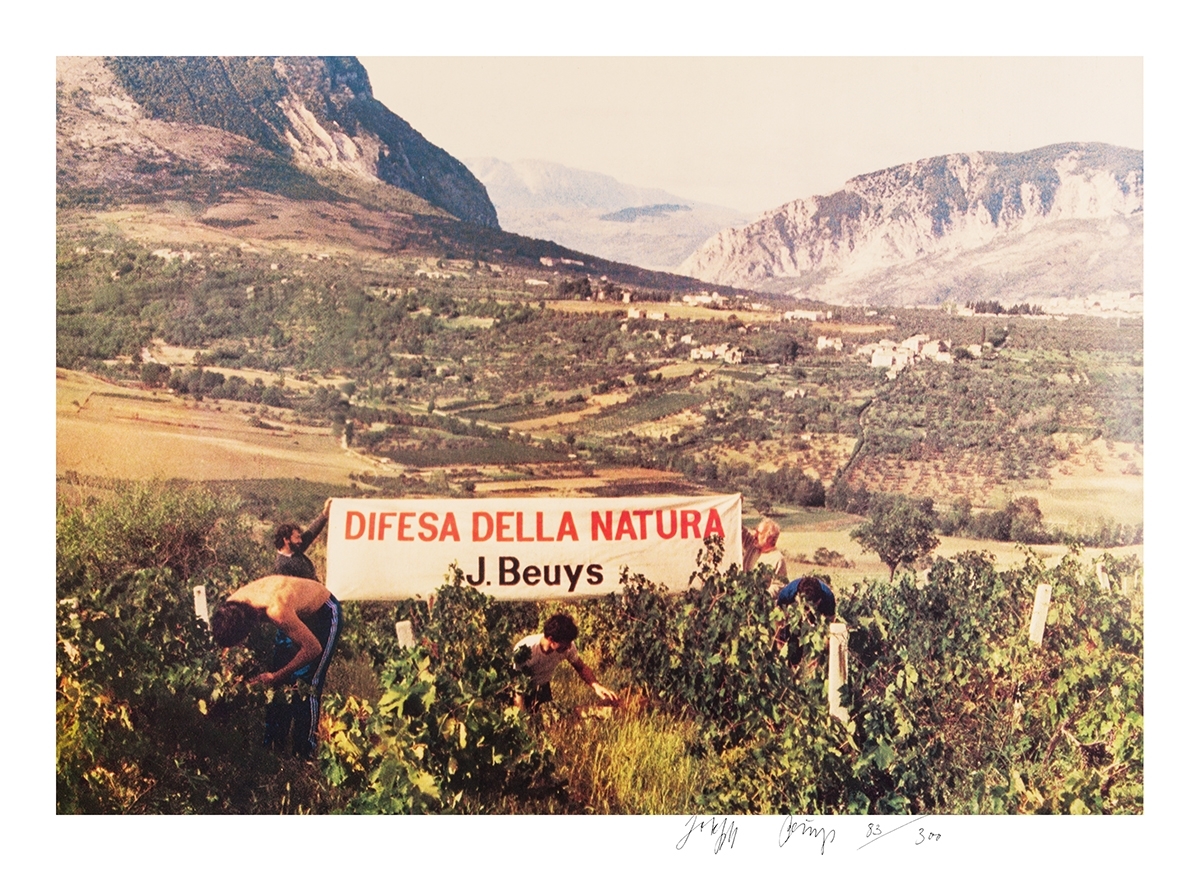
Joseph Beuys
Beuys was born in 1921 in Krefeld, Germany. Returning from the war, where he had served as a fighter pilot, he enrolled at the Düsseldorf Academy of Fine Arts in 1947. In 1961 he was elected professor at the State Academy of Fine Arts in Dusseldorf, and the following year he began to participate in Fluxus events, with which he was introduced by Nam June Paik and George Maciunas. In 1964 he participated in Documenta 3 in Kassel with drawings and plastic works from 1951-6. His presence at Documenta exhibitions would be continuous at each event until 1982, and his presence at the Venice Biennale (1976, 1980) and Sao Paulo (sole representative of the Federal Republic of Germany in 1972) was frequent and important. In the 1970s his activities became less frequent and installations gained ground, as did events of an ideological nature in the form of public debates or organised demonstrations and protests. The founding of the Organisation for Direct Democracy by referendum in 1972, the promotion of its aims with an organised information office in Kassel in the context of Documenta 5, and the occupation of the Dusseldorf Academy of Fine Arts led to his dismissal from the teaching post he held. In 1973 he founded the association for the promotion of a Free International University for Creativity and Interdisciplinary Research, and in 1974 he taught at the Hamburg School of Fine Arts. He would go on to establish the Free University in 1977 during Documenta 6. In 1978 he was made a member of the Berlin Academy of Fine Arts and in 1979 the Guggenheim Museum in New York organized a major retrospective exhibition of his work. In his works Beuys uses materials that are ephemeral, because in fact his primary aim is not the visual effect, but the ability to critique social reality and organised intervention. It was from this perspective that his association with the Fluxus movement emerged, which was based on the guarantees he was given for a completely open form of artwork without the need to accept a common artistic line. His theoretical pursuits are dominated by issues of philosophy, theology and anthropology, while at the same time he is intensively involved in the sciences and is particularly interested in music. He died in 1986 in Düsseldorf, Germany.


