
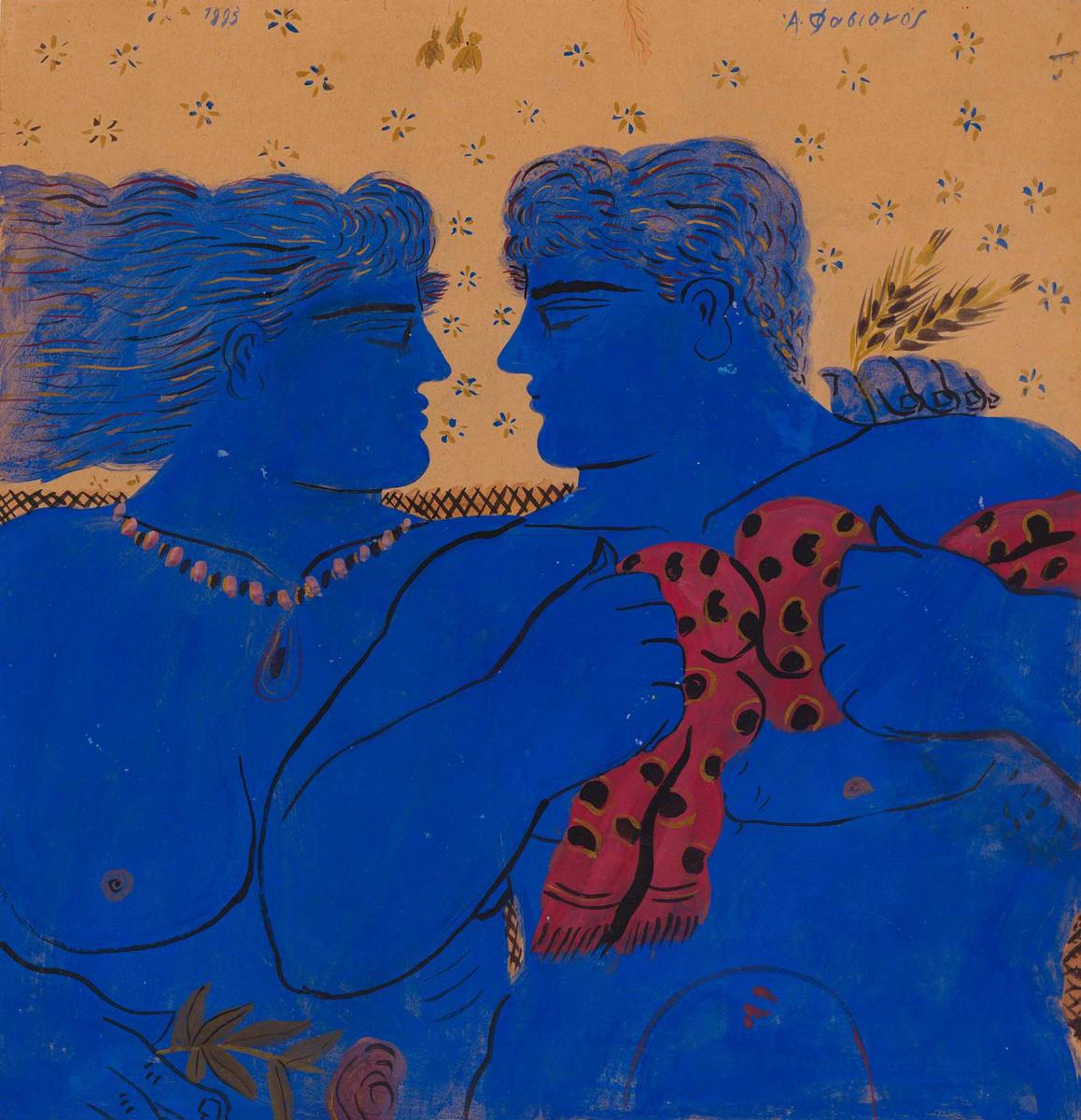
Αδάμ και Εύα
Αλέκος ΦασιανόςΟ Αλέκος Φασιανός τη δεκαετία του 1960 διαμορφώνει το προσωπικό ύφος της γραφής του τόσο θεματολογικά όσο και στυλιστικά, το οποίο ακολουθεί στο μεγαλύτερο μέρος της καλλιτεχνικής του πορείας, εξελίσσοντάς το. Με επιρροές από την αρχαία αγγειογραφία, τον ευρωπαϊκό μοντερνισμό, από τις βυζαντινές εικόνες και τη λαϊκή τέχνη, τον Θεόφιλο και το Τσαρούχη, τον Καραγκιόζη και το θέατρο σκιών αναπτύσσει την ποιητική και το όραμά του, που αντανακλάται στα έργα του.
Στη ζωγραφική σύνθεση «Αδάμ και Εύα», η απεικόνιση του ζευγαριού κυριαρχεί σε ολόκληρη σχεδόν τη ζωγραφική επιφάνεια, αφήνοντας μόνο ένα μικρό χώρο στο μονόχρωμο φόντο, το οποίο φέρει λιτά διακοσμητικά μοτίβα, που παραπέμπου σε ταπετσαρία τοίχου αστικού σπιτιού. Το σχέδιο αναδεικνύεται σε κυρίαρχο στοιχείο της δουλειάς του, που υλοποιεί τον χώρο, εντείνει την πλαστικότητα και τη μνημειακότητα των μορφών, την αίσθηση του ρυθμού και της κίνησης. Το χρώμα των μορφών, έντονο μπλε, ενιαίο, επίπεδο και με καθαρές γραμμές που μοιάζουν εγχάρακτες, ορίζει τα περιγράμματα των σωμάτων και τις βασικές τους λεπτομέρειες. Τα διακοσμητικά μοτίβα, το φουλάρι και το λουλούδι, καθώς και η κίνηση των μαλλιών της Εύας λειτουργούν σκηνογραφικά και πληροφορούν για τα πρόσωπα και την ιστορία που εκτυλίσσεται.
Alekos Fassianos was born in 1935 in Athens. He initially studied violin at the Athens Conservatory and then painting under the guidance of Yiannis Moralis at the Athens School of Fine Arts (1956-1960). With a scholarship from the French government, he studied lithography at the École des Beaux-Arts in Paris (1962-1964). After returning for a short period to Athens, he settled in Paris in 1966, where he lived and worked for a long period. From 1990 onwards, he divided his time between Athens and Paris.
In terms of subject matter, his artwork primarily features the human figure. In his early compositions, he depicted it with a spontaneous and unpretentious style. However, over time, the human figure gained a dominant presence in his works, transcending its physical dimensions and being portrayed with vibrant colours such as bright blues, strong reds, and intense yellows. His paintings often featured cyclists in suits and hats, smokers, swimmers, couples, lovers, and reclining youths, creating a sense of familiar everyday life. He also incorporated mythological themes into his works and introduced the use of a gold background in his paintings in the 1980s, drawing inspiration from Byzantine painting.
Alekos Fassianos received recognition for his artistic contributions. In 1999, he was honoured by the Academy of Athens, and in 2010, he was awarded the Legion of Honor by the French government. He passed away in Athens in 2022.


