
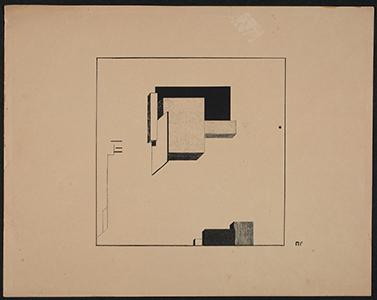
Proun 1c
Ελ ΛισίτσκιLazar Markovich Lissitzky (El Lissitzky) (Polchinok, Elnia district, Smolensk Province, November 22nd, 1890; Moscow, December 30th, 1941) studied at the Technical School in Darmstadt (Germany, 1909-1914). He traveled to France, Italy and Belgium. After returning to Russia (1914), he studied engineering and architecture at the Riga Technical University (1914-1916) and started working at Boris Velikovsky’s architectural studio. From 1917 to 1924 he illustrated Jewish books. In 1919 he was books. In 1919 he was invited by Marc Chagall, director of the School of Fine Arts in Vitebsk, to teach graphics and architecture. In the philosophical conflict that arose at the school that autumn, Lissitzky disagreed with Chagall and took Malevich’s part; under his influence, he began working in a Suprematist manner. In the winter of 1919/1920 he created his first Proun. He became a member of the “Unovis” (“Affirmers of the New Art”). In October 1920 he moved in Moscow, contacted with the International Bureau of The Visual Arts Department of the People’s Commissariat for Enlightenment (IZO NARKOMPROS) and with the Higher State Art-Technical Studios (VKHUTEMAS). In the end of 1921 he moved in Berlin, where he started to publish together with Ilia Ehrenburg the journal Veshch/Gegenstand/Objet. He published his book About two squares, which he had prepared for press already since 1920 in Vitebsk. He also participated in the preparation of the First Russian Art Exhibition in the “Galerie van Diemen” in Berlin (1922) and in Amsterdam (1923) and he created his Proun Room for the Great Berlin Art Exhibition (1923). In 1923 he designed Vladimir Maiakovskii’s book For the Voice, and published a portfolio of mechanical figures for Aleksei Kruchenykh’s and Mikhail Matiushin’s opera Victory over the Sun and six proun lithographs. In 1925 he published The -Isms of art, in a collaboration with Hans Arp. After his return to Moscow the same year, he designed horizontal skyscrapers. He taught at the Department of wood and metalwork at the VKHUTEMAS in Moscow (1925-1930). In 1926 he created The Room of Abstracts for the International Art Exhibition in Hannover. In 1928 he was appointed chief designer to the Soviet Pavilion at the Pressa exhibition in Cologne. In 1929 he designed the installations of the Soviet Stand at the Film and Foto Exhibition in Stuttgart and of the Soviet Pavilion at the International Fur Exhibition in Leipzig (1930). He regarded the design of exhibitions as a new artistic synthesis. In 1928-1929 he designed sets for Sergei Tretiakov’s play I want a child. In 1930 he published his treatise on modern architecture (Russia: Architecture or a World Revolution). Throughout 1930s he continued working as a book and exhibition designer. From 1932 onwards he was a permanent collaborator of the journal USSR in Construction. He suffered from tuberculosis and spent time in sanatoriums in Switzerland and Russia.


