
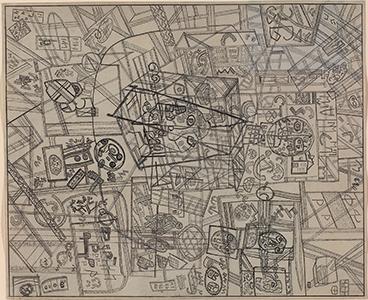
Untitled
Π. ΦιλόνοφPavel Nikolaevich Filonov (Moscow, January 8, 1883 - Leningrad, December 3, 1941) settled in Petersburg in 1896 and attended classes in painting and decorating houses until 1901. At the same time, he attended evening classes at the School of the Society for the Promotion of Arts (1898-1903 ). He then studied in the workshop of Lev Dimitrievv-Kafkasky (1903-1908) and at the Academy of Arts in Petersburg (1908-1910), from where he was expelled. He was a member of the "Youth Union" group and participated in three of its exhibitions. In 1912 he presented his works at the Donkey's Tail exhibition in Moscow. In the same year he traveled to Europe. He visited Austria, Germany, France and Italy. In 1913 he designed the scenery for Vladimir Mayakovsky's tragedy Vladimir Mayakovsky. In 1914 he began to illustrate Futurist books, including Futurists: Roaring Parnassus, published a book of "zaum" (superlatives) poems with his own illustration and title Hymn to Ecumenical Prosperity, as well as the manifesto Complete Paintings. In the same period he formulated the first ideas of his theory of analytical art. In the years 1916-1918 he served on the Romanian front. In 1919 he returned to Petersburg and participated in the First State Free Exhibition of Artistic Works. In 1923 he participated in the Painting Exhibition of All Tendencies of the Artists of Petroupoli. In the same year, he was associated with the State Institute of Art Education (GINHOOK). In 1925, together with a group of students and followers of his theory, he founded the "Group of Creators of Analytical Art" in Petersburg. The school operated until 1932, when it was disbanded due to increasing pressure from conservative artists and government officials. In 1932-33 he supervised together with his students the illustration of the edition of the Finnish epic Kalevala. In 1932 in Leningrad and 1933 in Moscow he presented his works at the exhibition Artists of the USSR in the last 15 years, 1917-1932. From 1934 until his death his painting follows the principles of analytical art.


