
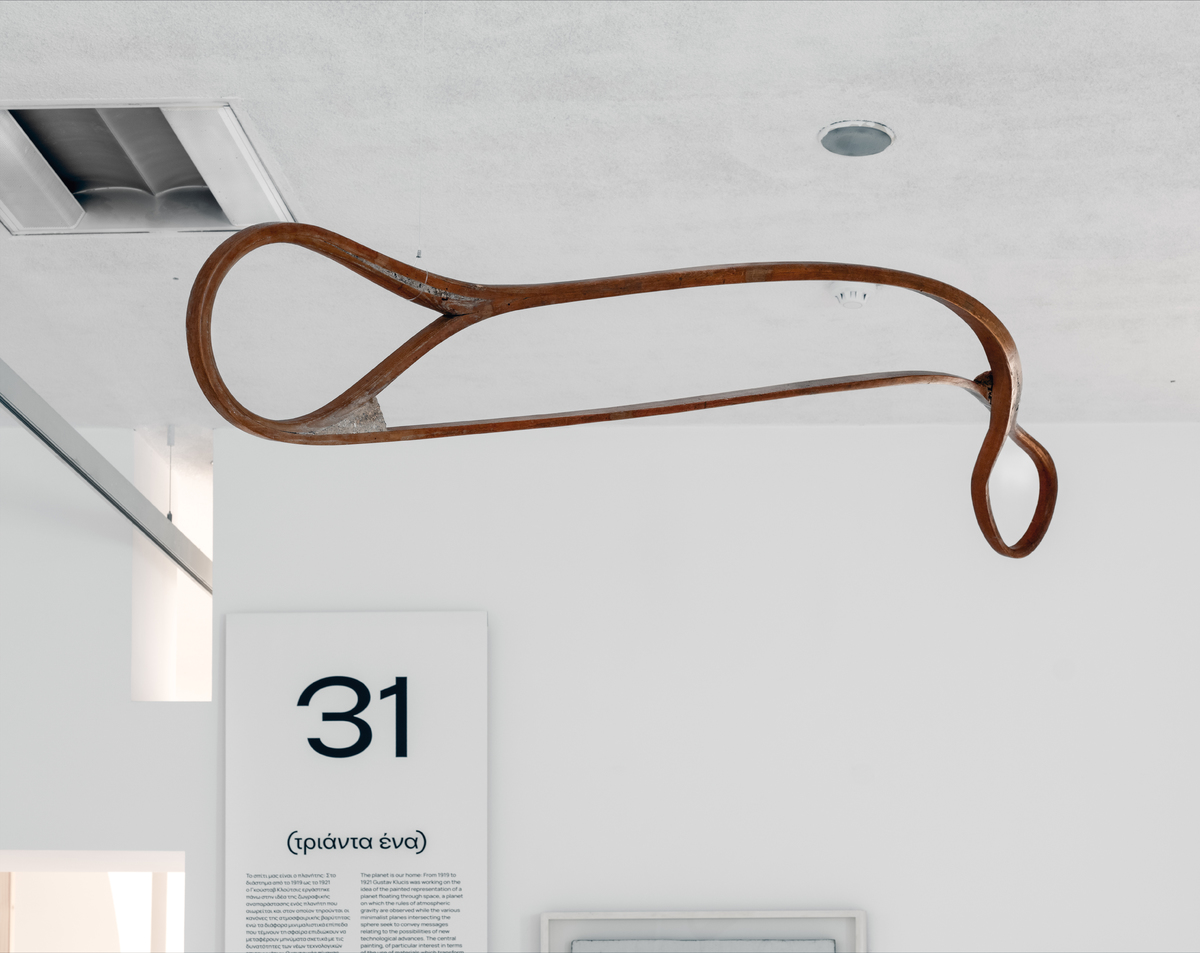
Sculpture Wing Strut for LETATLIN
Βλαντίμιρ ΤάτλινVladimir Evgrafovich Tatlin (Moscow, December 16th, 1885; Moscow, May 31st, 1953) attended the Institute of Painting, Sculpture and Architecture in Moscow (1902-1903) and studied at the School of Fine Arts in Penza (1905-1910). From 1911 till 1914 he exhibited at various exhibitions (Izdebsky Salons, Odessa, 1910-1911; “Union of Youth’s” exhibitions, St. Petersburg, 1911-1914; Donkey’s Tail, Moscow, 1912; Jack of Diamonds, Moscow, St.Petersburg, 1913; Contemporary Painting, Moscow, 1912-1913, 1914). In 1911 he organized a studio in Moscow called “The Tower” and designed the stage set for The Emperor Maximilian and his Disobedient Son Adolph by M.M. Tomashevsky; however, the scenery painters executed the designs so carelessly that Tatlin denied authorship. In 1912-1913 he worked on a series of sketches for the scenery and the costumes of Mikhail Glinka’s opera A life for the Tsar and in 1915-1918 for Richard Wagner’s opera The Flying Dutchman. In 1914 he traveled to Berlin and then to Paris, where he visited Picasso’s studio, and probably saw Picasso’s cubist constructions. He returned back to Russia and started working on his own counter-reliefs. On the 10th of May 1914, in his studio in Moscow, he held an exhibition of his first reliefs and counter-reliefs, “synthetic-static compositions”. He lived in Moscow, but spent long periods in Petrograd, where a circle of young artists was formed around him. In 1915 he participated in all the major avant-garde shows, including First Futurist Exhibition of Paintings: Tramway V and The Last Futurist Exhibition of Pictures: 0.10 in Petrograd and in the Painting Exhibition. The Year 1915 in Moscow. In 1916 he organized The Store exhibition in Moscow. In 1918 he collaborated with The Visual Arts Department of the People’s Commissariat for Enlightenment (IZO NARKOMPROS). He moved to Petrograd in 1919 and worked as an instructor at the Free State Art Studios (SVOMAS) in Petrograd. His workshop there was called Studio for Volumes, Materials and Constructions. At the same time he started working on the Monument for the Third International. In November 1920 the model was shown in Petrograd and then in Moscow. In 1923 he participated in the Exhibition of Paintings of Petrograd Artists of All Trends, he took an active part in the Institute of Artistic Culture (Inkhuk) and organized the production of Velimir Khlebnikov’s Zangezi. In the mid-1920s he started showing interest in applied art. In 1925 he took part in the Exposition Internationale des Arts Décoratifs et Industriels Modernes in Paris. From 1925 to 1927 he taught formal disciplines in the theatre and cinema department of the Art Institute in Kiev and from 1927 to 1930 he taught “culture of materials” in the Department of wood and metalwork at the Faculty of ceramics at the Higher State Art-Technical Studios (VKHUTEIN). From 1929 onwards he started working upon a flying machine, called Letatlin. In the 1930s-1940s he continued working as a stage designer and returned to figurative painting.


