
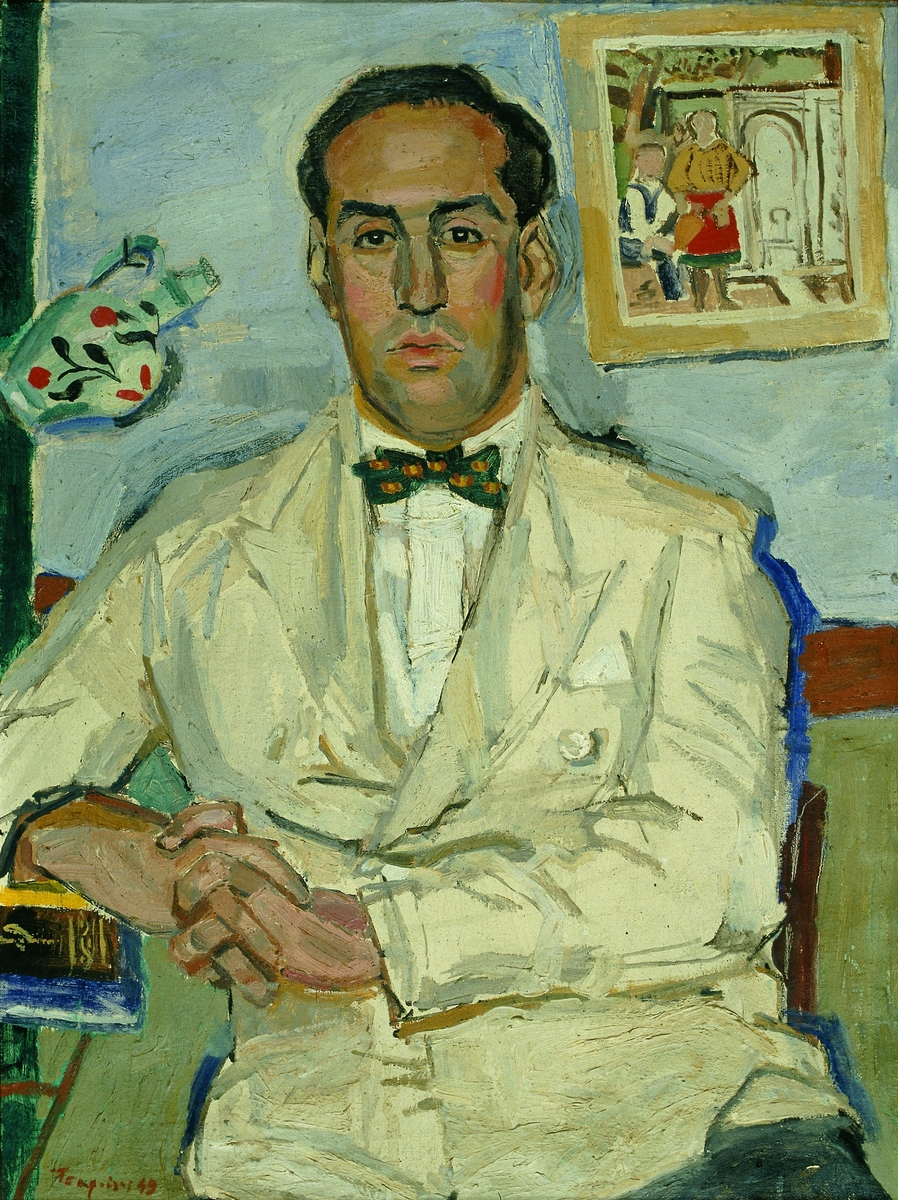
Portrait A.G.X.
Γιάννης ΤσαρούχηςYannis Tsarouchis was born in Piraeus in 1910. He studied at the School of Fine Arts under the tutelage of Sp. He studied at the Athens School of Fine Arts under the tutelage of F. Kontoglou (1931-1934), who introduced him to Byzantine painting, while he studied folk architecture and costume. Together with Pikionis, Kontoglou and Ag. Hadjimichalis, he was a pioneer in the demand of the time for the Greekness of art. In the period 1935-1936 he visited Constantinople, Paris and Italy, where he came into contact with works of the Renaissance, Impressionism, Cubism and Surrealism. Two years after his return to Greece, in 1938, he held his first solo exhibition at the Alexopoulou shop on Victory Street in Athens. In 1940 he was drafted and served on the Albanian front, and after the end of the war he held two solo exhibitions of watercolours and theatrical drafts. In 1951 he exhibited in Paris and London and in 1953 he signed a contract with the Iolas Gallery in New York (until 1957). He was nominated for the Guggenheim Prize (1956) and in 1958 he represented, together with G. In 1958, he represented Greece at the Venice Biennale with G. Moralis. From 1967 to 1980 he lived in Paris and returned to Greece in 1980. In 1982, he opened the Museum G. M. Moura in Paris and returned to Greece. Tsarouchis in Maroussi in the artist's house, donating his personal collection of works. At the same time, the Tsarouchis Foundation operates in order to disseminate the painter's work.He designed sets and costumes, collaborating with the National Theatre, the Art Theatre, the Scala in Milan, the Opera in Dallas, the Olimpico Theatre in Vicenza, Covent Garden in London and with Duchamp and Cacoyannis in films. In 1977 he staged Euripides' Troads in his own modern Greek performance with his own teaching & set design. He was also involved in weaving, book illustration, translating and writing books on art. He died in 1989 in Athens. Tsarouchis was one of the most distinguished representatives of the so-called "generation of the '30s", who made a special effort to combine the demands of "Greekness" with the idiom of "modernism". From the teachings of Parthenis and Kontoglou, the posters of Karagiozis, the portraits of Fayum and the images of Theophilos, he draws the structure, the richness of form and colour, elements that are however presented in a metamorphosed and transmuted form. His main thematic axis is the human form: he was concerned with the male nude, which in his work acquires a particular expressiveness. Later he turned to a more westernized painting. At the same time as his visual work, he was also extensively involved in set design. With the wide range of his artistic activities he subsequently influenced several Greek artists.


