
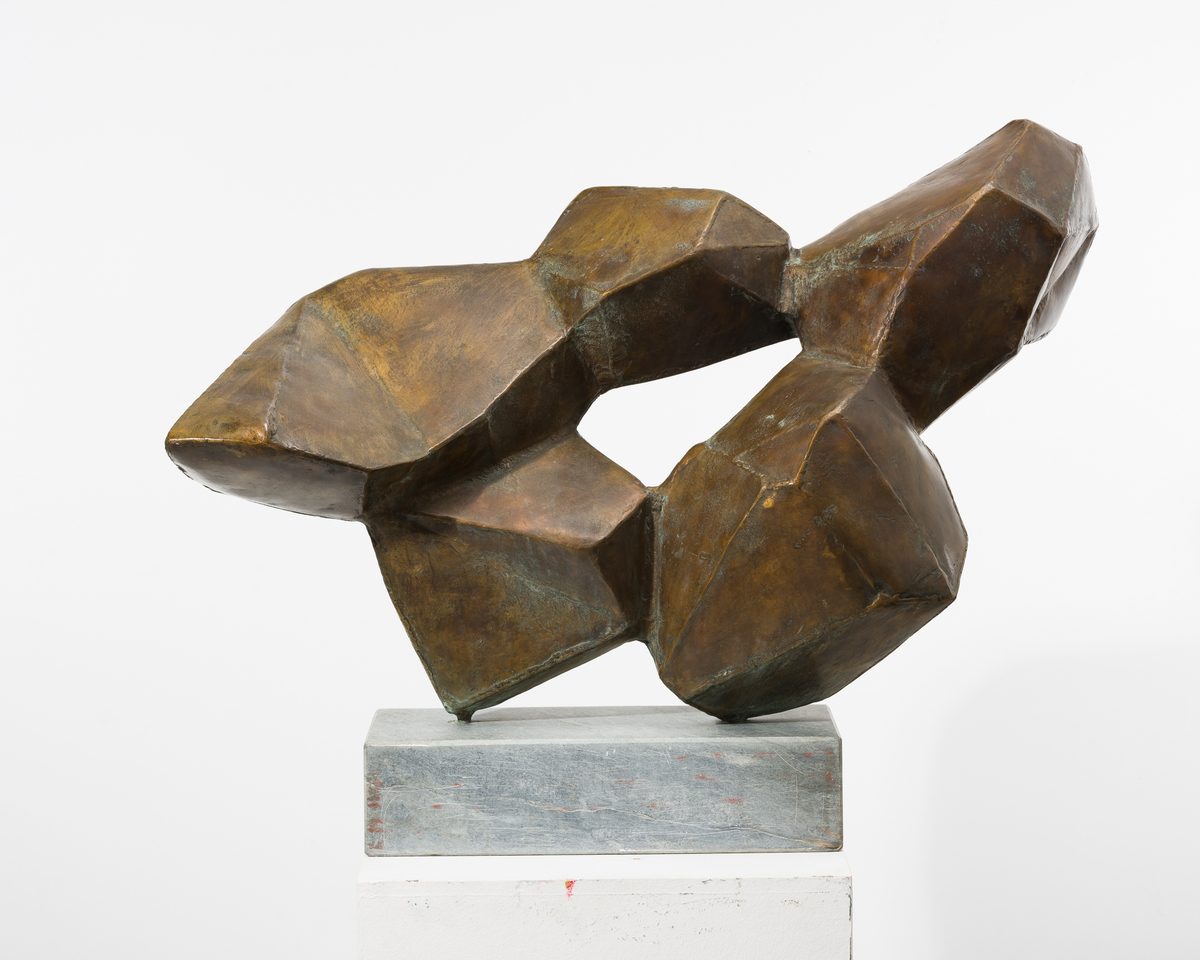
Κλέαρχος Λουκόπουλος
Klearchos Loukopoulos was born in Thermo, Aetolia, in 1906. He became interested in art at an early age, taking his first drawing lessons from Konstantinos Maleas. In 1924 he studied for three years at the Athens Law School, while he also attended violin lessons at the National Conservatory and drama lessons at the National Theatre. In 1934 he moved to Paris where he studied sculpture at the Académie Colarossi (1934-1936) and after the war he studied in the studio of Thanasis Aparte.
His work was awarded many prizes and distinctions: Medal at the Panhellenic Exhibition (1948), Prize of the International Art Critics' Exhibition by the Greek section of AICA (1963), First State Prize (1972, which he refused in protest to the dictatorial regime). An active member of many artistic groups (Armos, Alpha, Group for Communication and Art, Association of Contemporary Art), he played a decisive role in the reception of modernist sculptural trends in Greece.
He was one of the pioneers in the reception and establishment of modernist sculptural trends in Greek art. His realistic efforts in the interwar years will give way, after the war, to sculptures that impose their anthropocentric content and archaic abstraction, while influences from Mycenaean figurines are also evident. From the early 1960s, he uses metal predominantly and is led into more abstract and then constructivist pursuits with solid geometric compositions, structured with purity, rigour and simplicity.


