
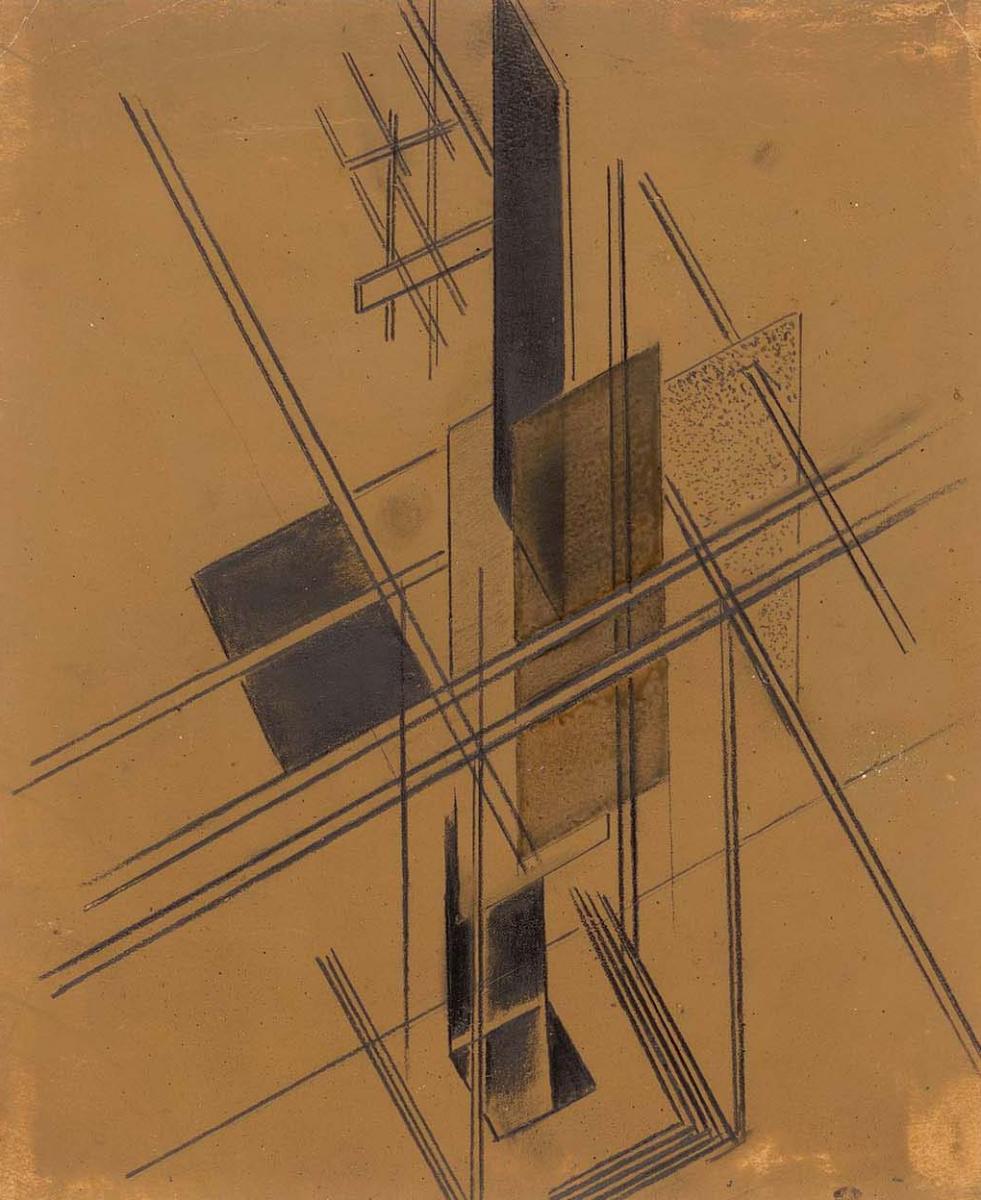
Construction
Gustav KlucisGustav Gustanovich Klucis was born in 1895 in Rujiena, Latvia. He began his artistic education by studying at the Pedagogical School in Volmar from 1911 to 1912. In the following years, from 1913 to 1915, he attended the School of Fine Arts in Riga. He later moved to Petrograd (now St. Petersburg), where he studied at the School of the Society for the Advancement of the Arts until 1917. During this time, he also worked as a scenographer at the Okhtensky Workers' Theater. Klucis' interest in the fine arts led him to study at the Free State Art Studios (SVOMAS) and the Higher State Art and Technical Workshops (VHUTEMAS) in Moscow. It was during his studies that he came into contact with Kazimir Malevich and the new artistic movement of Suprematism. However, he quickly shifted his focus towards Constructivism. He was particularly active in creating a multitude of drawings, paintings, prints, and photomontages. One of his notable artworks from 1922 is a series of drawings for propaganda pavilions that combined sound, image and motion. In the mid-1920s, he taught colour theory at the Higher State Art Studios while simultaneously participating in exhibitions of avant-garde artists in Russia and abroad. He also engaged in typography, drew posters and installations and was one of the designers of the Soviet pavilion at the 1937 World Exposition in Paris. However, in 1938, he was arrested as a member of the "Latvian Operation" group and executed in Moscow.


