
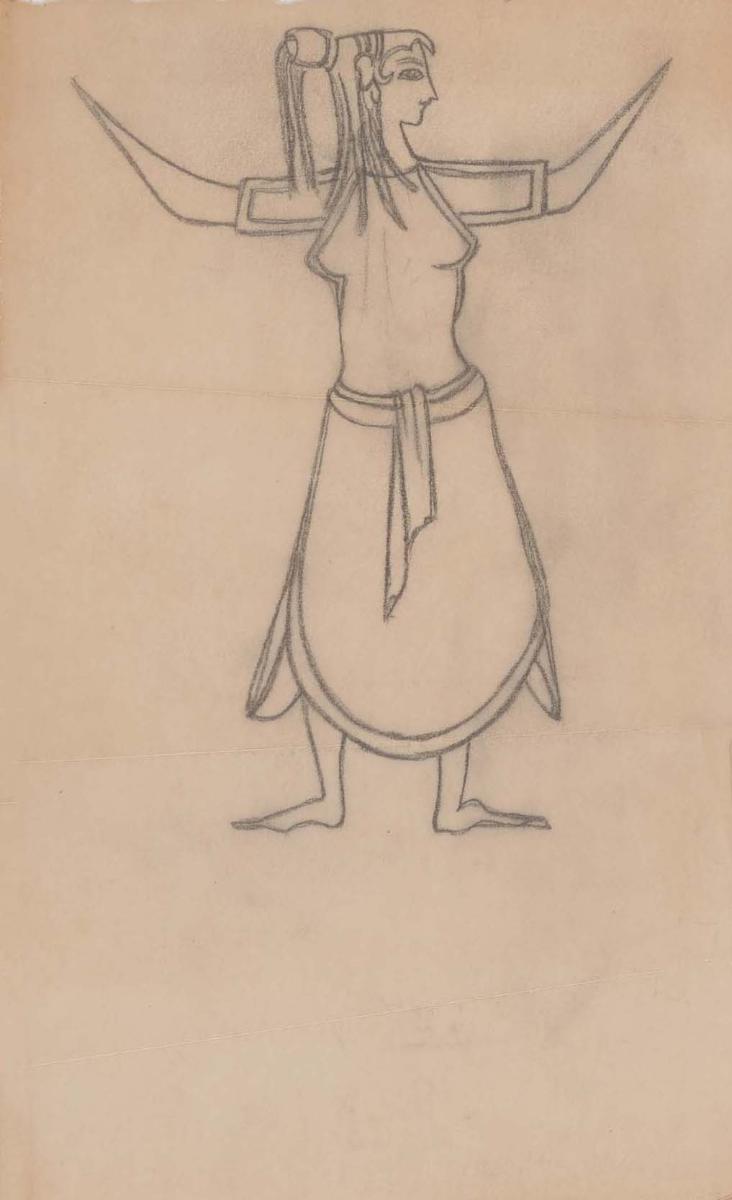
Μελέτη κοστουμιού για την παράσταση “Θησέας” – Κοστούμι χορεύτριας
Άλεξ ΜυλωνάΤο 1961 η Άλεξ Μυλωνά σχεδιάζει τα σκηνικά και τα κοστούμια για την παράσταση «Θησέας» του Έλιοτ Κάρτερ για το Ελληνικό Χορόδραμα της Ραλλούς Μάνου. Έχοντας ως κύρια έμπνευσή της το έργο της σε σίδερο «Μυκήνες» δημιουργεί σκηνικά περιβάλλοντα σε μεγεθυσμένη εκδοχή, τα οποία χαρακτηρίζονται από τη γεωμετρικότητα της σύνθεσης, τις αυστηρές φόρμες και την έντονα αφαιρετική διάθεση.
Τα σχέδια για τα κοστούμια της φέρουν έντονα στοιχεία ελληνικότητας και διαχρονικότητας των θεμάτων, επηρεασμένα πιθανόν από τα έργα της λεγόμενης γενιάς του ’30 (Μόραλης, Τσαρούχης, Χατζηκυριάκος-Γκίκας κ.ά.). Είναι ξεκάθαρες οι αναφορές στις μινωικές τοιχογραφίες, ενώ διακρίνονται και μοτίβα από τη μινωική αγγειογραφία, που χαρακτηρίζονται από τη λιτότητα, τη γεωμετρία και την καθαρότητα των συνθέσεων. Τα χρώματα που κυριαρχούν στις συνθέσεις των κοστουμιών κόκκινο, μπλε, χρυσό και μαύρο προσδίδουν μια λαμπρότητα και μεγαλοπρέπεια στους χαρακτήρες.
Alex Mylona was born in Athens in 1923. From a young age, she showed an interest in painting and received her first lessons. She studied sculpture at the Athens School of Fine Arts (1945-1950) under the guidance of her teacher, M. Tombros.
The early period of her work mainly consisted of representational sculptures focusing on the human form. Her move to Paris in the 1960s and her encounters with significant artists such as H. Arp, A. Giacometti, and O. Zadkine were transformative and shaped her artistic oeuvre. From her early anthropocentric compositions in the 1950s, she progressed to create abstract sculptures in wrought iron characterized by frontality, strict immobility, speed, sharp endings, and a play of lines that included void form and vertical surfaces. Through the rotations, folds, curves, movements, and tensions of pliable metal elements in architectural proposals, she arrived at the deeply worked simplicity of sculptural form and the purity of geometric marble surfaces, combining circles, semicircles, squares, and rectangles. In addition to her sculptural work, Mylona created a plethora of works on paper, engaged in painting, and drew the sets and costumes for the Greek Dance Theater of Rallou Manou.
She presented her work in numerous solo exhibitions in Greece and abroad, while her participation in international group exhibitions was significant. In 1960, she represented Greece at the 30th Venice Biennale, in 1961 at the São Paulo Biennial, and in 1967 at the International Exhibition of Montreal, as well as at the Biennials of Alexandria, Buenos Aires, and others.
In the mid-1990s, she permanently settled in Greece and worked between Athens and Syros. In 2004, the Alex Mylona Museum was founded, where she donated her work. In 2007, the building, along with her work and archive, was transferred to the Macedonian Museum of Contemporary Art (MMCA). In 2018, with the establishment of MOMus - Metropolitan Organization of Visual Arts Museums of Thessaloniki, MMCA and MOMA became part of the new organization. She passed away in Athens in 2016.


