
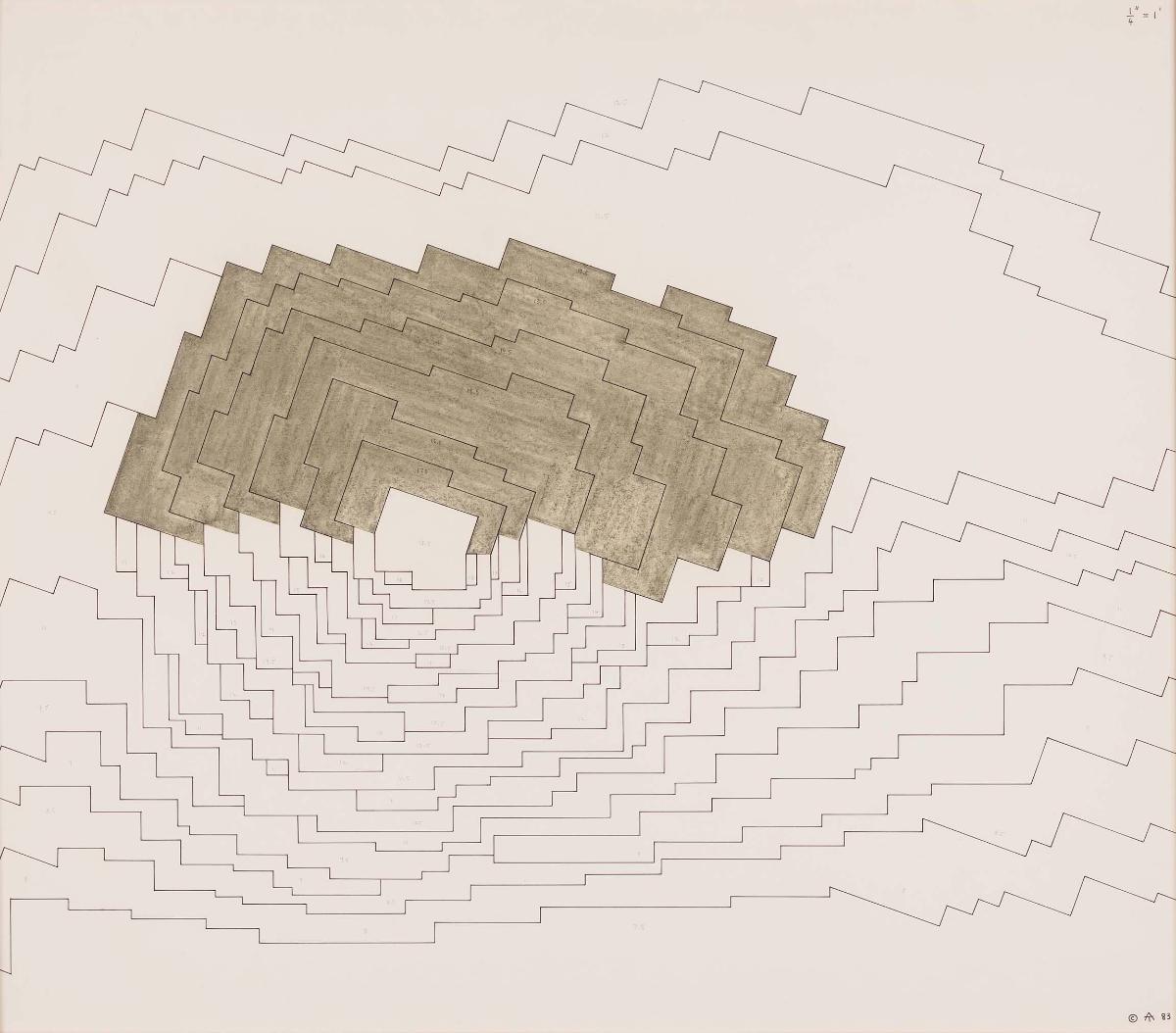
Μνημείο Ινδία-Πακιστάν
Αθηνά ΤάχαΣτις αρχές της δεκαετίας του 1980 η Αθηνά Τάχα δημιουργεί σχέδια και μακέτες αρχιτεκτονικών μνημείων που προορίζονταν για «Μνημεία Σφαγής», αφιερωμένα σε γεγονότα που σφράγισαν τη νεότερη και σύγχρονη ιστορία. Τα σχέδια, τα οποία ανήκουν στη συλλογή του Μουσείου Σύγχρονης Τέχνης, αφορούν: 1) το Μνημείο Χιροσίμας-Ναγκασάκι, 2) το Μνημείο Εβραϊκού Ολοκαυτώματος, 3)το Μνημείο της Κεντρικής Αμερικής, και 4) το Μνημείο Ινδίας-Πακιστάν. Οι προτάσεις αυτές, οι οποίες πραγματοποιήθηκαν το 1983 αλλά δεν υλοποιήθηκαν ποτέ, βάζει στο στόχαστρο τα θύματα των τραγωδιών και επιχειρεί να επουλώσει τις πληγές τους διατηρώντας ζωντανή τη μνήμη τους. Στόχος της είναι να προκαλέσει τη διέγερση της μνήμης του θεατή μέσω της σωματικής εμπειρίας και μέσω μιας προσωπικής διαδρομής που επιχειρεί να διαμορφώσει στις μορφολογίες των μνημείων. Η όλη αυτή της προσέγγιση παρουσιάζει τον τρόπο με τον οποίο η γλύπτρια αντιλαμβάνεται την τέχνη της στο δημόσιο τομέα και πως επιθυμεί να την κάνει προσβάσιμη σε όλους και όχι μόνο σε μια πνευματική ελίτ, η οποία μπορεί να επισκέπτεται μουσεία ή να τη αγοράζει.
Athena Tacha was born in Larissa in 1936. From 1954 to 1959, she studied sculpture at the Athens School of Fine Arts (ASFA) in the workshop of Michalis Tombros, while also pursuing studies in the French Institute. With a Fulbright scholarship, she conducted postgraduate studies at Oberlin College in Ohio from 1960 to 1961. Subsequently, she went to Paris on an IKY scholarship, where she completed her doctoral thesis in aesthetics and art history (1961-1963) and obtained a diploma in museology from the Louvre School. In 1963, she returned to the United States, where she settled permanently and worked for a decade, initially as an assistant curator and later as a curator at the Allen Memorial Art Museum at Oberlin College. From 1973 to 1998, she held the position of sculpture professor at Oberlin College, and from 1998, she moved to Washington, D.C., and taught at the Department of Art at the University of Maryland.
Her work has received numerous awards and grants. Since 1970, she has been creating large-scale outdoor sculpture and conceptual photography. She has worked with a wide range of materials, including stone, bricks, concrete, steel, water, plants, and lighting, producing more than fifty public environmental sculpture works in various American states, such as Alaska, Arizona, New York, Philadelphia, Florida, and others. Early in her artistic career, she defined the theoretical and sculptural basis upon which she built her work, exploring new concepts related to space, time, and matter. Her work is concerned with movement, flow, and the harmony of the world, influenced by her engagement with the theory of relativity, ancient philosophy, and her research into scientific theories about the structure of the universe and cosmological matters, shaping her artistic idiom.


