
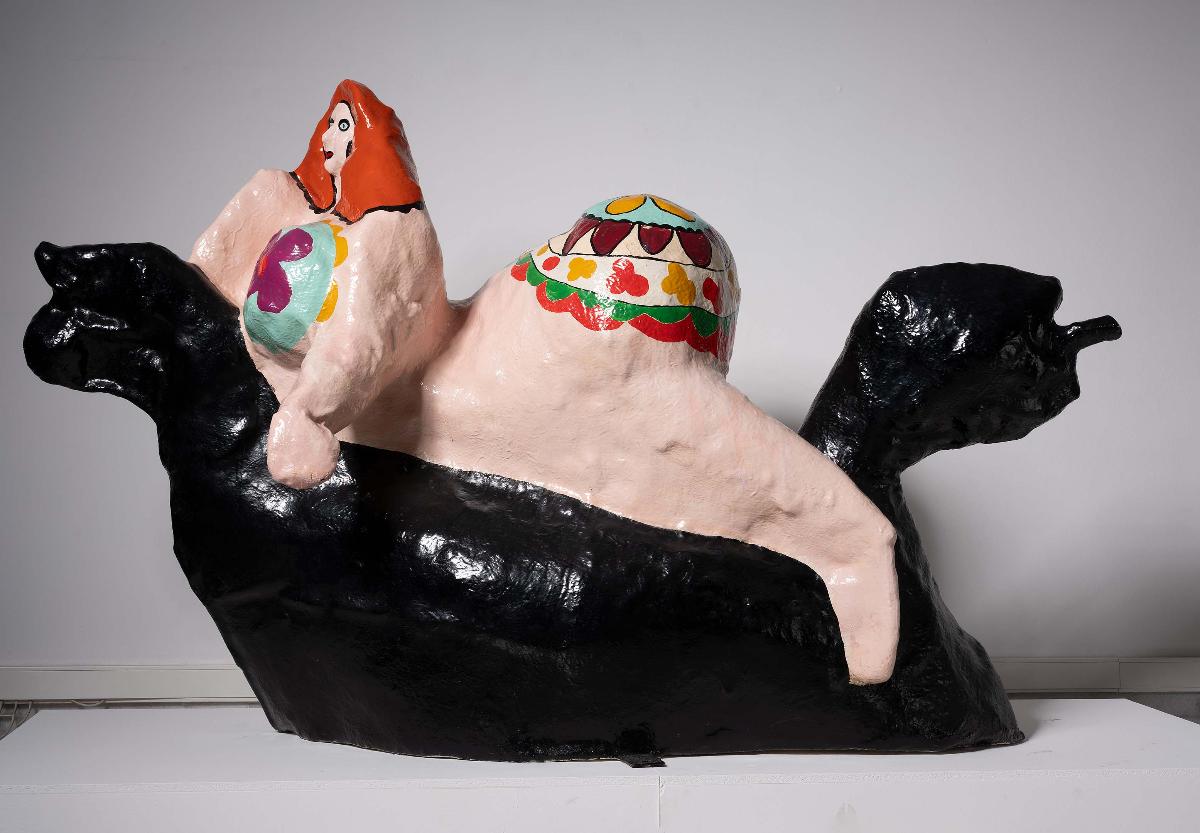
Εύα
Niki De Saint PhalleΣτα μέσα της δεκαετίας του 1960 η De Saint Phalle ξεκινά να δημιουργεί μια σειρά έργων που εγκαταλείπουν το επίπεδο και απλώνονται στον τρισδιάστατο χώρο. Είναι η περίοδος των ανώνυμων μαύρων γυναικών και των Nanas της, των χοντρών ευτυχισμένων γυναικών που προκύπτουν έχοντας ως μοντέλο μια φίλη της έγκυο. Τα πρώτα έργα ήταν κατασκευασμένα από υφάσματα πάνω σε έναν ευλύγιστο σκελετό, στη συνέχεια όμως υιοθετείται ο πολυεστέρας, το πεπιεσμένο χαρτί, στα οποία η De Saint Phalle επεμβαίνει με λαμπερά χρώματα. Παραδείγματα αυτής της περιόδου αποτελούν τα έργα «Αδάμ» και «Εύα» του 1968, στα οποία διακρίνονται ορισμένα μόνιμα στοιχεία, όπως τα υπερμεγέθη σώματα με τις έντονες παραμορφώσεις, τα μικρά κεφάλια και τα υπερτονισμένα γεννητικά όργανα, χαρακτηριστικά που ακολουθούν ολόκληρη τη σειρά των έργων.
Niki de Saint Phalle (Catherine-Marie-Agnès Fal de Saint Phalle) was born in 1930 in Neuilly-sur-Seine, France, to a French father and an American mother. Her family, which was very wealthy and had a long history, was affected by the Great Crash of 1929, leading some members to move to New York. Niki and her brother soon followed. At the age of 17, seeking to escape her family's unhealthy environment, where she had suffered abuse from her father at the age of 11, she started working as a model. The artist has a mental breakdown when she discovers that her husband is cheating on her, and she was hospitalized in a psychiatric clinic in Nice, where she began to paint. After being discharged from the hospital, she travelled across Europe, coming into contact with contemporary art movements of the time. During one of her trips, she met Jean Tinguely, her future companion, and joined the "New Realists" group established by Pierre Restany in October 1960. Niki de Saint-Phalle, the only female artist in the group, developed a close relationship with Alexander Iolas, who consistently supported her throughout her artistic career. She embarked on her artistic journey through actions and interactive works, often using a shooting technique where she, along with the audience, would fire paint from guns onto surfaces and installations. Later on, in an ironic take on the Italian Renaissance, she created chapels and cathedrals, which she also shot and destroyed. However, her most famous body of work is the "Nanas," the cheerful and voluptuous female figures. Through these sculptures, Niki de Saint Phalle celebrated femininity, women's independence, and her own liberation through the world of art.
She passed away in La Jolla, California, in 2002.


