
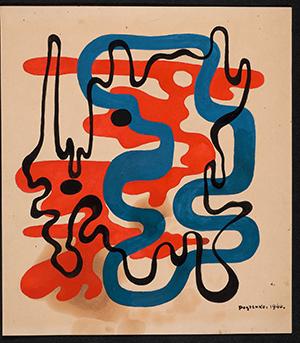
Untitled
Α. ΡότσενκοAleksandr Mikhailovich Rodchenko (St.Petersburg, November 23rd, 1891; Moscow, December 3rd, 1956) attended the School Fine Arts in Kazan (1910-1914), where he met his future wife Varvara Stepanova. After his graduation he moved to Moscow and attended the Stroganov Art and Industry Institute. The first major exhibition in which he participated was The Store (Moscow, 1916), organized by Vladimir Tatlin. His familiarity with the Suprematism of Malevich and Rozanova, as well as with Tatlin’s counter-reliefs and Kandinsky’s theories, played an important role in his evolution and integration as an artist. In 1918 he had a one-man show at the “Club of the Leftish Federation” in Moscow. From 1915 onwards, he executed a series of compass-and-ruler paintings and drawings, on the basis of his theory of Linearism, which he applied upon three-dimensional folding and hanging mobile constructions during the years 1920-1921. From 1918 onwards he worked on various sections of The Visual Arts Department of the People’s Commissariat for Enlightenment (IZO NARKOMPROS) and played an important role in the artistic life of Moscow. He was also member (1919-1920) of a group called “Zhivskulparkh” (“Commission of Painterly-Sculptural-Architectural Synthesis”) and participated in two exhibitions in Moscow in 1920. He also exhibited at the Tenth State Exhibition: Non-objective Creation and Suprematism (Moscow, 1919), where he was the first to show spatial constructions as well as in the Exhibition of Four (with Kandinsky, Stepanova and Sinezubov) in Moscow (1920). He was a founding member of the Institute of Artistic Culture (INKHUK) in 1920 and at the same year was one of the instigators (with Kandinsky and others) of a network of art museums throughout the country. He became professor at the Higher State Art-Technical Studios (VKHUTEMAS) and at the Higher State Art-Technical Institute (VKHUTEIN), where he taught for ten years (1920-1930). He was a member of the Productivist group. He participated in the second (1920) and the third (1921) exhibition of the “Society of Young Artists”, in the exhibition 5 x 5 =25 in Moscow (1921) and in the First Russian Art Exhibition at the “Galerie van Diemen” in Berlin (1922). In the 1920s he worked with Vladimir Maiakovskii in the field of advertising and in close association with the magazines LEF (Left Front of the Arts) and Novyi LEF (New Left Front of the Arts). In 1925 he made the designs for a worker’s club, which were exhibited at the Soviet Pavilion at the Exposition Internationale des Arts Décoratifs et Industriels Modernes in Paris. In the late 1920s he laid stress on photography, stage design, typography and graphic design. During the 1930s he executed numerous designs for the magazine USSR in Construction and started painting. In the early 1940s he produced paintings in an abstract style.


