
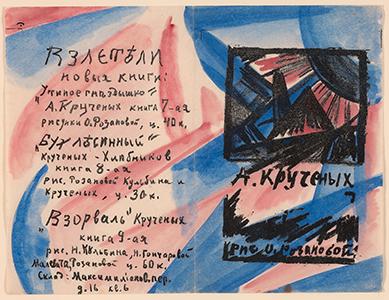
New books by A. Kruchenykh. Advertisement for the poetry collections of Α. Κruchenykh.
Όλγα ΡοζάνοβαOlga Vladimirovna Rozanova (Melenski, Vladimir Province, June 21st, 1886; Moscow, November 8th, 1918) studied in Moscow from 1904 to 1910, at the private school of painting and sculpture of A.Bolshakov, at the Stroganov Art and Industry Institute as well as at the studios of Ivan Dudin and Konstantin Yuon. In 1911 she moved to St.Petersburg and briefly studied at the Zwantseewa School of Art. She was one of the most active members of the avant-garde in St.Petersburg and joined the “Union of Youth”, participating in its exhibitions and its magazine (1910-1914). She illustrated publications of the Futurist poets Velimir Khlebnikov and Aleksei Kruchenykh, who became her husband in 1916, and others, including A Game in Hell, a collaboration between Khlebnikov and Kruchenykh, which was reissued in 1914 with illustrations mad by Malevich and herself; A Little Duck’s Nest of Bad Words by Kruchenykh (1913); Let’s Grumble by Kruchenykh (1914); the miscellany Futurists: Roaring Parnassus (1914); Transrational Book by Kruchenykh and Aliagrov (Roman Jakobson) (1916). In 1916 Rozanova collaborated with Kruchenykh for two books, War and Universal War, which she illustrated with non-representational cut-paper collages. She exhibited in most of the major avant-garde shows of 1915-1916, including First Futurist Exhibition of Paintings: Tramway V and The Last Futurist Exhibition of Pictures: O.10 in 1915 in Petrograd and The Store and Jack of Diamonds in 1916 in Moscow. From 1916 to 1917 she was a member of the “Supremus” group and in 1918 joined the People’s Commissariat for Enlightenment (IZO-NARCOMPROS), where, together with Rodchenko, she was in charge of the subsection for Applied Art and contributed to the development of the Free State Art Studios (SVOMAS) in several provincial towns. She also worked in the field of textile design and embroidery. A posthumous exhibition of her work was held in Moscow in 1919 which was shown within the framework of the Tenth State Exhibition: Non-objective Creation and Suprematism. Her work was included in the First Russian Art Exhibition, at the “Galerie van Diemen” in Berlin (1922).


