
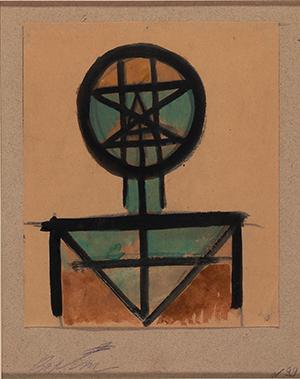
Composition (Head)
Β. ΣτεπάνοβαVarvara Fedorovna Stepanova (Kaunas- Kovno, Lithuania, November 5th, 1894; Moscow, May 20th, 1958) studied at the School of Fine Arts in Kazan (1910-1911) where she met Aleksandr Rodchenko, her future husband. In 1913 she moved to Moscow, studied under Ilia Mashkov and Konstantin Yuon and entered the Stroganov Art and Industry Institute. She exhibited at the Fifth State Exhibition: From Impressionism to Non-objective Art (1918-1919) and the Tenth State Exhibition: Non-objective Creation and Suprematism (1919) in Moscow. She participated in the Exhibition of Four (Moscow, 1920 -with Kandinsky, Rodchenko, and Nikolai Sinezubov), in the exhibition 5 x 5 = 25 (Moscow, 1921) and also in the First Russian Art Exhibition at the “Galerie van Diemen” in Berlin (1922). During the years 1917-1919 she wrote zaum poetry. In addition she created non-representational collage and calligraphic books. In 1918 she joined The Visual Arts Department of the People’s Commissariat for Enlightenment (IZO NARKOMPROS) and during the years 1920 - 1923 she was an active member of the Institute of Artistic Culture (INKHUK). In 1922 she designed the costumes and sets for Aleksandr Sukhovo-Kobylin’s Death of Tarelkin, in which, under the direction of Vsevolod Meierkhold, she worked out variations on mechanical, robotlike constructions of the human figure. She also designed sets for Vitalii Zhemchuzhyi’s Book Evening in 1924. In 1923-1924 she began workins as a textile designer together with Liubov Popova at the First State Textile Print Factory in Moscow. From 1923 to 1928 she was closely associated with the journal LEF (Left Front of the Arts) and Novyi LEF (New Left Front of the Arts), edited by Osip Brik and Vladimir Maiakovsky. Stepanova was a member of the Productivist group with Rodchenko, Popova and Tatlin. Furthermore, she taught in the Textile Department of the Higher State Art-Technical Studios (VKHUTEMAS) from 1924 to 1925. In 1925 she participated in the Exposition Internationale des Arts Décoratifs et Industriels Modernes in Paris. From the mid-1920s onwards she focused on graphic design, on typographic and poster design as well as on cinematography. In the 1930s she worked for several magazines including USSR in Construction. She started painting again in the late 1930s.


