
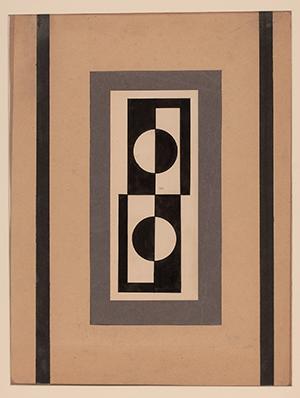
Untitled
Π. ΜανσούροφPaul Andréevitch Mansouroff or Pavel Mansurov (Павел Мансуров) (Saint-Petersburg, March 2nd, 1896; Nice, France, February 2nd, 1983) was an understated painter of the Russian avant-garde movement of the 1920s. He was as well addressed as graphic artist and master of decorative and applied arts. Mansouroff’s contribution to the avant-garde in Russia was a wholly non-objective art that used elongated vertical surfaces to explore questions of space and spatial correlations. In 1968 he declared his works to not have any subject and be exclusively abstract. He continuously stated that if something can be identified in his art, that would only be the result of pure coincidence. In 1909 Mansurov entered the Central School of Technical Drawing of Baron Alexander Stieglitz, where he studied anatomy under the guidance of V. E. Savinsky and different kinds of etching under V. V. Matai. At the same time he attended the Drawing school under the Society for the Encouragement of the Arts (OPKh). In 1916–1917 Mansurov met K. S. Malevich, V. E. Tatlin, P. N. Filonov, M. V. Matyushin, V. V. Kandinsky; he was interested in avant-garde theories and ideas and he began to propagandise new art. At that time the artist painted his first abstract works. In 1917 he was engaged in interior design of the Literary and Artistic cabaret Comedians’ Halt (“Prival Komediantov”). Influenced by his friends, Malevich and Tatlin, Mansouroff made his first public exhibit of his abstract works in 1918 at Winter Palace in Leningrad. In 1918 Mansurov also created scene and costume designs for the ballet Upmann: Kuritel’naia Shutka on the music by Arthur Lourié at the Chinese Theatre in Tsarskoye Selo; he also took part in design of the play Mystery-Bouffe by V. V. Mayakovsky. The artist created booklet Poor Folk by N. N. Punin. However, Mansouroff quickly moved away from the influence of his entourage and developed a more personal and instinctive style. Alongside with other artists Mansurov participated in festive decoration of Petrograd for the first anniversary of October revolution, he painted decorative panels Europe and Asia for the Saint Isaac’s Square. Mansurov attended the studio of Tatlin at Ostozhenka, in particular he assisted him in work under the monument of the Third International. In 1919 Mansurov took part in the First State Independent Art Exhibition in Petrograd. In 1919–1920 Mansurov lived in Kazan. He was arrested by the Cheka (the All-Russian Emergency Commission for Combating Counter-Revolution and Sabotage) on suspicion of desertion, and was put for several months into prison. At the end of 1920 — the beginning of 1921 Mansurov taught at Kazan Art School. In 1921–1927 the artist worked for the Museum of Artistic Culture in Petrograd and headed the experimental section at the State Institute of Artistic Culture (GINKhUK), where he made a report and called for consolidation of all avant-garde artists in 1921. Mansurov exhibited his works at the First Russian Art exhibition in the Van Diemen gallery in Berlin in 1922, at the Exhibition of works by Petrograd artists of all art movements in 1923, at the 14th International exhibition of fine arts in Venice in 1924. Mansurov had to leave the USSR because of attacks at avant-garde artists. In 1928 he travelled to Rome for his personal exhibition, and then he has not returned to the USSR. In 1929 he settled in France. Mansurov began to create drawings for textile with the assistance of Robert Delaunay, and later he became famous in this field. Mansurov began to collaborate with many famous Paris fashion houses Chanel, Hermes, Lanvin and others. At the same time the artis’'s abstract works weren’t successful in Europe, in 1930s he returned to his traditional manner of painting. In 1936 he took part in the exhibition of Russian Artists at the gallery Zak in Paris. Mansouroff is known for his paintings on wood, referred to as “Pictural formulae.” In the 1950s, he started making frequent trips to Nice and Saint-Paul de Vence. He settled there in 1975 and died in Nice on 2 February 1983.


