
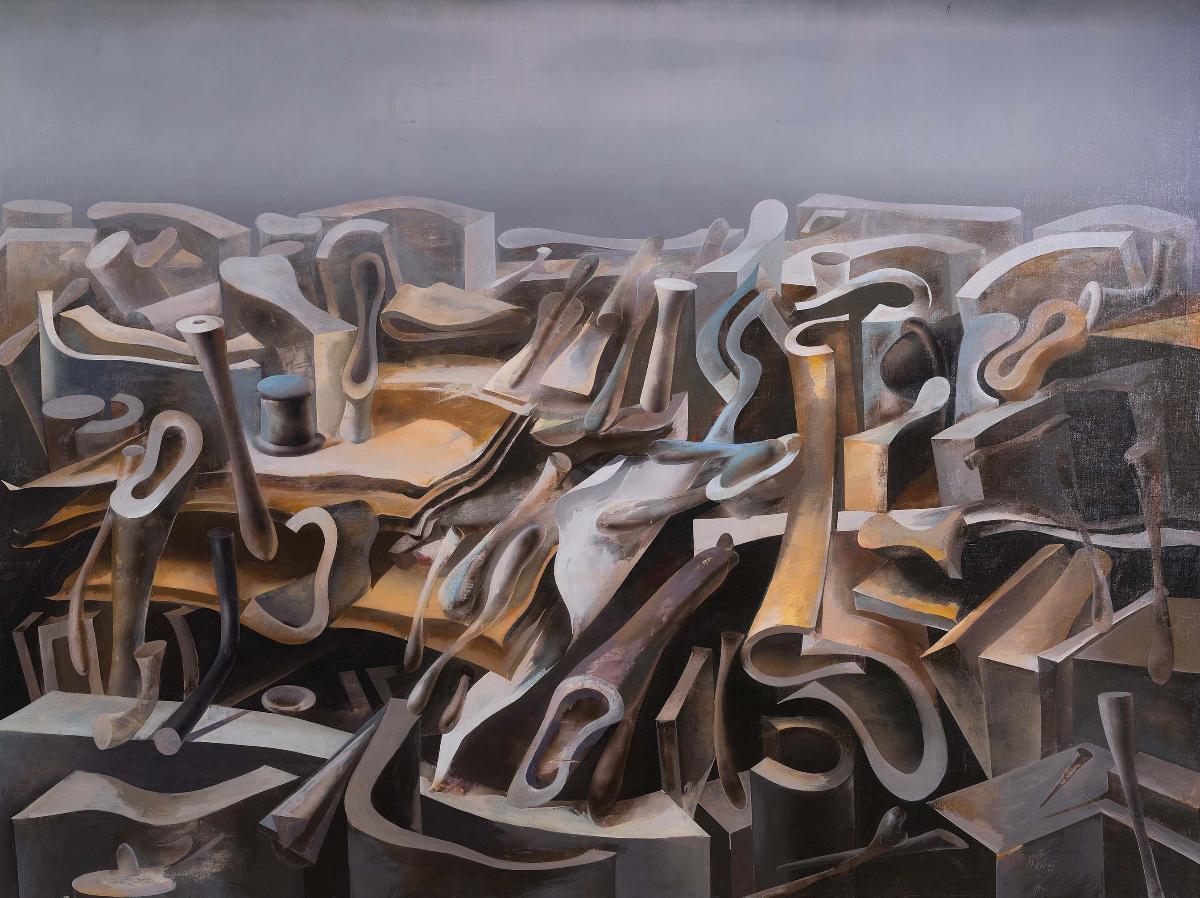
Ιεριχώ
Χρίστος ΚαράςΟ Χρίστος Καράς στα μέσα της δεκαετίας του 1970 υιοθετεί μια πιο μεταφυσική προσέγγιση και δημιουργεί μια ενότητα ζωγραφικών συνθέσεων που ο ίδιος χαρακτηρίζει «διαστημική ποίηση», που περιέχει στοιχεία φανταστικά, σουρεαλιστικά που συνδυάζουν εικόνες της πραγματικότητας με αναφορές στην τεχνολογία. Εισάγει αντικείμενα με συγκεκριμένη μορφή, αλλά αφηρημένα και απροσδιόριστα ως προς την ταυτότητά τους: σωληνοειδή σχήματα και ελάσματα, ορθογώνιους όγκους, καμπυλωμένα επίπεδα, βέλη, κώνους, τα οποία αιωρούνται, συστρέφονται και περιστρέφονται σε ένα ονειρικό τοπίο, το οποίο φαντάζει εξωπραγματικό. Δίνει προτεραιότητα στο σχέδιο, ενώ το χρώμα, λαμπερό και καθαρό, με τις εναλλαγές των θερμών και ψυχρών τόνων έρχεται να τονίσει την πλαστικότητα του σχεδίου. Οι τίτλοι που δίνει στα έργα του τονίζουν το συμβολικό περιεχόμενό τους, όπως στο έργο της συλλογής του Μουσείου Σύγχρονης Τέχνης «Ιεριχώ, που αποτελεί χαρακτηριστικό παράδειγμα αυτής της περιόδου και στο οποίο επιχειρεί να απεικονίσει τα ερείπια της βιβλικής πόλης μέσα σε ένα διαστημικό τοπίο.
Christos Karas was born in 1930 in Trikala, Thessaly. After briefly studying at Panteion University (1948-1950), he attended the Athens School of Fine Arts (ASKT) under the guidance of teachers such as G. Moralis, A. Georgiadis, and G. Pappas from 1951 to 1955. In 1957, he moved to Paris, where he studied Fresco at the École des Beaux-Arts with a scholarship from the Greek State Scholarships Foundation (IKY). He remained in Paris until 1963, traveling to various European countries during this time. Upon his return to Greece, he actively participated in the creation of a contemporary artistic climate. In 1963, he founded the group "Tomi" along with other artists and took part in the organization of the First Congress of Greek Visual Artists. In 1976, he co-founded the Artists' Association (Synetismos Kalitexnon). During the period of 1973-1975, he went to New York with a Ford Foundation scholarship, where he worked for two years while simultaneously traveling to major American cities and Canada. In 1977 and 1981, he participated in symposia with the themes "Establishment of a Museum of Contemporary Art in Greece" and "Contemporary Art and Tradition," respectively. He exhibited his work in numerous solo and group exhibitions in Greece, as well as in major cities in Europe and America. In 1984, he represented Greece at the Venice Biennale. He passed away in Athens in 2023.


