
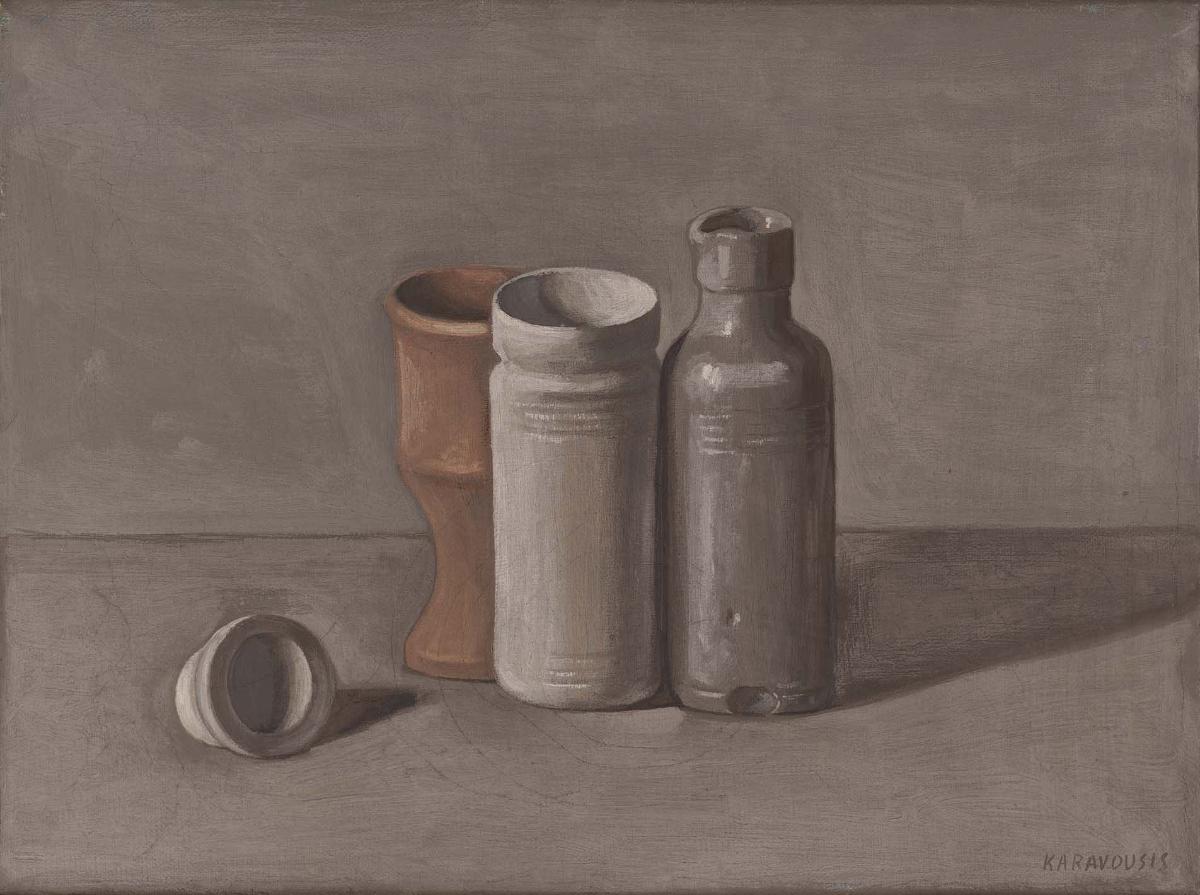
Νεκρή φύση
Σαράντης ΚαραβούζηςΗ «Νεκρή φύση» του Σαράντη Καραβούζη αποτελεί χαρακτηριστικό παράδειγμα της πρώτης περιόδου του καλλιτεχνικού του έργου. Ο καλλιτέχνης δημιουργεί μια επιμελημένη σύνθεση με λιτή δόμηση, τοποθετώντας τα τρία αντικείμενα στο κέντρο της ζωγραφικής επιφάνειας. Μέσα σε εσωτερικό χώρο χωρίς προοπτική, ο φωτισμός αντανακλάται στα αντικείμενα και γίνεται κατά κύριο λόγο αντιληπτός από τις σκιές που αυτά δημιουργούν.
Sarantis Karavousis was born in 1938 in Athens. He studied painting at the Athens School of Fine Arts (1959-1963) in the laboratory of G. Moralis. In parallel, he also explored mural painting and scenography. With a scholarship from the Greek State Scholarships Foundation (IKY), he travelled throughout Greece in the years 1965-1966 to study Greek art. He taught drawing at the Centers for Technological Applications in Athens in 1966. The following year, with a scholarship from the French Government, he studied at the École des Beaux-Arts in Paris (1967-1968). He continued his studies at the École Pratique des Hautes Études and the École du Louvre, primarily focusing on printmaking. He held his first solo exhibition in Greece in 1971 at the Kallitexniko Pnevmatiki Kentro Ora (Artistic and Intellectual Center Ora) and went on to participate in numerous solo and group exhibitions in Greece and abroad. In 1984, he was honoured for his artistic work with the Drouant-Cartier Award.
During the first period of his work he painted, with obvious influences from the painting of G. Morandi, he painted still lifes and compositions with objects in spaces without clear boundaries and perspective, using mainly earthy tones. Later, he directed compositions that exuded a lyrical atmosphere, incorporating enigmatic objects, archaeological findings, statues, and ruins, creating an artificial perspective that transformed realistic representation into metaphysical poetry. In parallel, he explored engraving and drawing in a similar vein, as well as micro-sculpture.


